

Australia’s housing crisis isn’t “global” — it’s policy-driven
Australia’s housing crisis isn’t “global” — it’s policy-driven. With supply falling behind demand, expanding low-deposit schemes and other demand boosters risks inflating prices rather than improving affordability. The reset is clear: build more homes faster, align population growth with construction capacity, and stop policies that turn scarcity into higher bids.
Why Join the NEWS Adventure (JtA)? JtA NEWS gives a voice to those who need it and puts events on the record that are in the public interest. Guided by Join the Adventure North Star, JtA NEWS holds truth and right to information at its journalistic core.
JtA NEWS · HOUSING RESET
Still wondering why every inspection is a bunfight and every auction is a bloodbath?
This article cuts through the spin on migration, demand schemes and housing supply — and explains why the deck feels stacked against renters and first-home buyers.
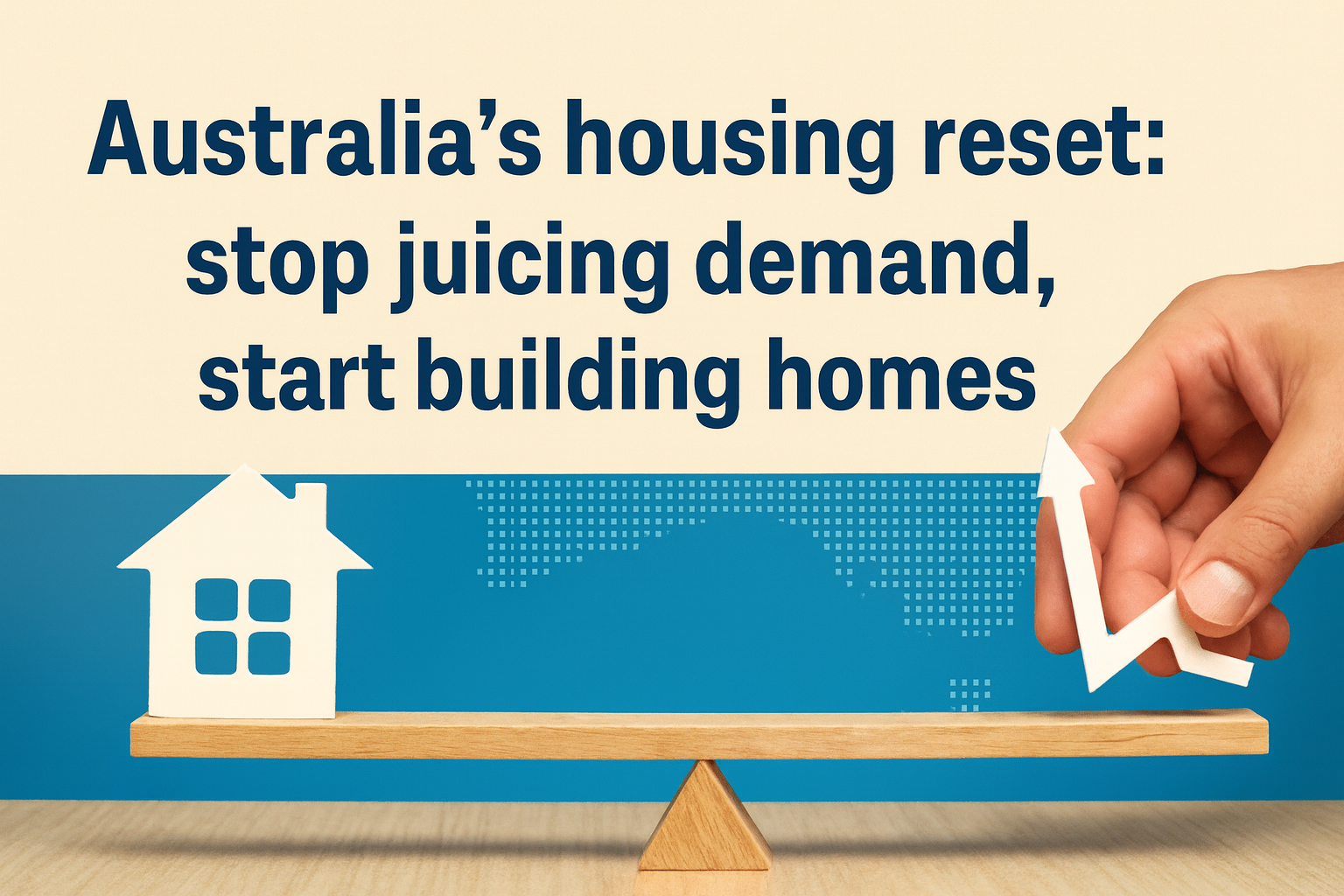
Australia’s housing crisis didn’t happen by accident. It is the predictable result of political settings that keep demand elevated while supply lags — and then try to patch the consequences with policies that can intensify competition for scarce homes.
The latest flashpoint is the expansion of the federal Home Guarantee settings from 1 October 2025, which removed income caps and effectively removed limits on places, while still retaining eligibility rules and (higher) property price caps.[1] Supporters argue this helps more Australians into home ownership. The risk is timing: when housing supply is already behind demand, expanding access to low-deposit purchasing power can end up inflating prices rather than improving affordability.
This article is broad in nature and is not financial advice. Reach out to a JtA Licensed Property Specialist to get information specific to you.
That risk is compounded by the underlying shortage. The National Housing Supply and Affordability Council estimates 177,000 dwellings were completed in 2024, against underlying demand of 223,000.[2] With a gap like that, demand-boosting measures can push the market in the wrong direction.
Population growth adds a second layer of pressure. ABS data shows Australia’s population reached 27,536,874 at 31 March 2025, up 1.6% over the year. Net overseas migration contributed 315,900, compared with natural increase of 107,400.[3] While net overseas migration has come down from its recent peak, it remains materially higher than pre-pandemic levels.[4]
Recent reporting citing Home Affairs figures puts temporary visa holders at 2,925,604 as at end October, spanning cohorts such as New Zealand citizens, international students, temporary graduates, skilled workers, working holiday makers and tourists.[5] Bridging visas stand out in the same reporting. For historical context, Home Affairs stock data shows 102,220 bridging visa holders at 30 June 2015.[6]
Overseas, the contrast is increasingly clear. In New Zealand, annual net migration has fallen sharply to around 10,600 in the year to August 2025.[7] At the same time, Trade Me’s Rental Price Index shows national rents easing — about 4% down year-on-year by October 2025.[8] In Canada, Rentals.ca reports asking rents down 3.2% year-on-year in September, the twelfth consecutive month of annual declines.[9]
The countries doing housing best aren’t “lucky”. They’ve made structural choices — especially planning and supply settings — that enable housing to be delivered at scale, as often cited in discussions of Tokyo’s housing system.[10] Singapore’s long-run approach also shows what supply discipline can look like: over 80% of residents live in HDB housing, while home ownership remains around 90%.[11]
Australia’s reset is simple to describe and hard to execute: stop inflating demand, speed approvals, fund enabling infrastructure, embrace well-located density, scale social and affordable housing, and align migration settings with what the nation can actually build.
Sources
- Australian Government / Housing Australia — Home Guarantee changes effective 1 Oct 2025.
- National Housing Supply and Affordability Council — State of the Housing System 2025 (completions vs underlying demand).
- Australian Bureau of Statistics — National, state and territory population (year to 31 Mar 2025; NOM and natural increase).
- Australian Bureau of Statistics — Overseas Migration 2023–24 (NOM 446,000; prior year record 536,000).
- news.com.au report citing Home Affairs — temporary visa holders total and cohort breakdown (end Oct).
- Home Affairs — bridging visa holders stock at 30 Jun 2015 (102,220).
- Stats NZ / NZ migration reporting — net migration ~10,600 year to Aug 2025; prior peak 136,700 year to Oct 2023.
- Trade Me — Rental Price Index (late 2025: rents down ~4% YoY).
- Rentals.ca / Urbanation — Canada asking rents down 3.2% YoY; 12 straight months of annual declines.
- Discussion of Tokyo housing supply/market outcomes (comparative planning/supply settings).
- Singapore housing system (HDB share; home ownership rate).
Leave a Reply
You must be logged in to post a comment.